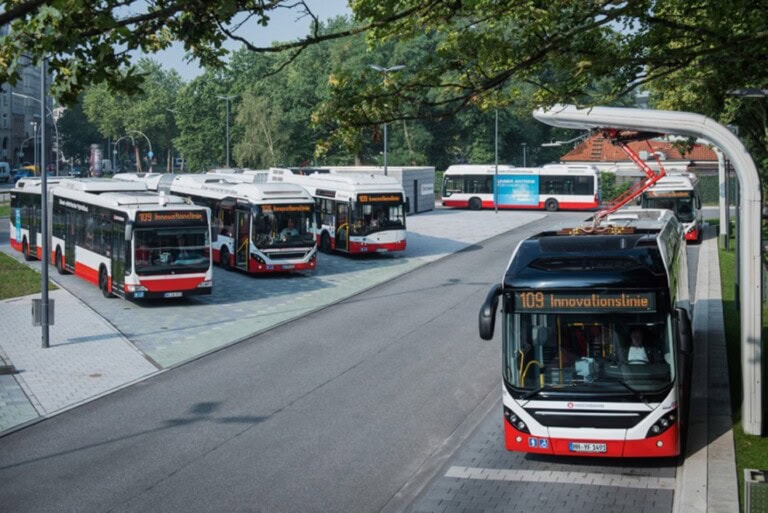
With most metropolitan areas targeting zero-emission environments, an increasing number of cities and transport companies are considering a fully electric solution for their urban bus network.
In this context, UITP Academy and Hamburger Hochbahn designed this training programme on the operations of Electric Buses to offer a comprehensive overview on the operations, maintenance and asset management of electric buses.
This training will give you an insight into urban bus networks, the importance of building a sustainable infrastructure, recent technologies, and using data for the operation, maintenance, scheduling and implementation of efficient timetables on city routes.
Adapt your bus operations towards a sustainable city
Introduce the electric solution, the different types of technologies, and compare their benefits and drawbacks
Understand the different types of vehicles and required infrastructure to operate and such vehicles
Discover the products on offer and the mainstream technology options available, the maturity level of suppliers, the various competition
Understand how to develop an operational and charging strategy
Learn how to plan, implement and run electric bus lines successfully
Understand how technology and data management can help optimise your operations and charging
Learn from successful major electric bus project operations and maintenance
Listen to best practices
Who is it for?
Project managers, engineers and other professionals eager to learn more about the technology, the implementation and the running of electric buses
Staff from public transport operators who works in operation and maintenance
Staff from the bus industry worldwide involved in the market uptake of electric buses
Professionals interested in obtaining a wider and international perspective on electric buses and eager to learn more from international best practice
NB: A good level of English is a compulsory requirement to attend the training.
A top level methodology
Get inspired by our trainers– understand the main aspects of Travel Information / Wayfinding design and learn from successful best practice
Participate ininteractive sessions– with course trainers and with course participants
Challenge your practical knowledgeon the effectiveness and quality of Public Transport Information Service Provision
Address topics and issues from aninternational perspective, enriched by different cultural approaches and points of view
Participate inpractical exercises ‘in the field’, allowing you to apply the principles and methods learnt during the course
Benefit from a unique exchange of knowledge and experiencebetween professionals
Make the best out of the learning platform, MyAcademy
UITP Training Programmes and all related processes are certified for ISO29990:2010 – the standard for learning services for non-formal education and training.
Inspiring trainers
Our skillful trainers are composed of international experts and professionals with extensive experience and knowledge in the strategic, operational and technological areas of electric buses.
Programme
Welcome & Introduction to the course and Expectation Analysis
09:00–10:00
The policy context and city strategies for the introduction of electric buses
Legislation/policy aspect: how to incentivize e-buses deployment with a focus on the EU Clean Vehicles Directive mandatory country targets and other international examples
Current state of the global electric bus market, the products on offer
Main challenges for deployment: upfront costs, operational requirements, procurement, interoperability, cooperation with energy sector.
Planification of charging infrastructure, a quite critical part when planning to deploy e-buses
The system approach and steps of an implementation and deployment process
Break
11:00–11:30
Case Study – Implementing and optimising large e-bus fleet operations
11:30–12:00
This session will look into new technologies and auxiliaries used to run electric busses, whether it be the installation and running of charging infrastructure, the impact on information technology systems, driver assistance and standardisation of the connection or the technical evolution of the battery.
This session includes:
An insight into vehicles (battery, plus-in hybrid, trolley, fuel cell) and infrastructure (overnight and opportunity charging, types of pantographs, in-motion charging)
Stae of the market from indusrty perspective
Updated electric bus product overview: latest models and trends
Requirements and performance: standardization, interoperability.
Impact on operations: LCC, Maintenance, data, autonomy and performance.
Contractual framework: system approach, share of risks, commitment.
International experience in operating electric buses.
Break
16:00–16:30
Case Study – Overnight solution and Opportunity solution
16:30–17:30
Workgroup: exercise on scheduling a bus lines
Discussion on exercise results
Session 4: Electric Buses – Maintenance and Depot adptation
09:00–10:30
Case Study: Depot adaptation: solutions and success factors
10:30–11:00
Break
11:00–11:30
Managing successful efficient driving on bus operators has been a must for combustion vehicles. Urban EV fleet present a new challenge and possibilities for improving energy consumption and overall performance. Homogenizing driving styles according to vehicle makers and incorporating a continuous improving methodology can decisively contribute to a predictable operation, minimizing potential issues. This session will show how to walk the way in a successful approach.
Case Study: the control center – Operations
12:30–13:00
Lunch
13:00–14:00
Energy consumption, charging and overall performance need be monitored and managed in the most optimal way to ensure efficient and seamless electric bus operations. How to intelligently use data to achieve such performance will be presented and discussed in this session. Continuous improvement by integration of smart data (feedback loop) for the optimisation in operational simulations is thereby the key.
Case Study: Smartcharging
15:15–15:45
Break
15:45–16:00
Technologies cell type
Behaviour
Management systems
Lifetime
Standards
Safety
Thermal management
Models
Evaluation exam
18:00–18:30
Location
HOCHBAHN bus depot
Tessenowweg 2
22297 Hamburg
Trainers
Arnd BÄTZNER
Founder
Baetzner Metropolitan
Switzerland
Arnd Bätzner provides consulting and government advisory on the alignment of multi-modal transit systems with the built environment and strategic land use planning. Focus areas include the integration of shared, demand-responsive transport with high-capacity modes, the role of data in autonomous driving, and bus electrification.
Arnd did part of his Ph.D. research on leveraging walkability in Hong Kong, Singapore and Jakarta. He chairs the Austrian Federal Ministry of Transport’s strategic advisory board and is a previous chair of the UITP Trolleybus Committee.
Sophie SCHAAR
Project Manager Electric Buses
Hamburger Hochbahn AG
Germany
Sophie graduated with a Diploma Degree in Mechanical Engineering & Bachelor of Business Administration from RWTH Aachen.
She worked in the control of development scopes in the interior as SE-Teamleader for BMW.
With MAN Truck & Bus SE she carried out cost analysis in the area of plastic components, then worked on component and system responsibility for interior scopes & managed the project team for cabin development of the electric truck.
Since October 2021 she works at HOCHBAHN in Hamburg as Project Manager for System Integration of electric buses and more recently as Project Manager for the electric buses.
Jean-Laurent FRANCHINEAU
Strategy Manager
ZE TEAM
France
Back-ground
Currently Strategic leader inside ZE Team of Transdev Group. I have experiences of 28 years in Mobility Issues and Public Transport, starting in VEOLIA Environment and continuing now inside TRANSDEV group. I have been involved in many cooperative innovative mobility projects at EU and French levels, including ITS standardization activities for CEN and a research institute in Eco-Mobility. Now, I work in the ZE Team of TRANSDEV as Strategic Manager to ease cross-fertilized mobilities transition initiatives to Zero Emission.
Expertises
New energies including Charging system for E-Bus, H2, Biofuels and Safety issues in PT
ITS in Public Transport and ADS in automotive industries
Diplomats
Engineering Degree, Automotive and Aeronautical Mechanics, ESTACA (France)
Engineering Degree, Space Telecommunications, ISAE Sup’aero (France)
Claudius JEHLE
CEO / Managing Director
volytica diagnostics GmbH
Germany
Claudius Jehle is founder and CEO of volytica diagnostics GmbH, a company focusing on easy, safe and independent battery quality and health assessment. Claudius studied Mechanical Engineering and System Identification in TU Munich and TU Delft until 2012, and was then leading the research group Energy Storage Diagnostics and Telematics at the Fraunhofer Institute for Transportation and Infrastructure Systems IVI, Dresden, from 2013 until 2019.
Besides his role as CEO, Claudius is giving lectures on Battery Basics and Battery Degradation, writing knowledge base articles and is giving speeches and presentation on the global topic of batteries, the involved value chains and the potentials around independent battery diagnostics.
Catharina MICHELS
Group Manager of Presales Engineering
Optibus
Israel
Catharina Michels – Group Manager of Presales Engineering at Optibus – Catharina leads the presales engineering teams in the EMEA region. During her five year tenure at Optibus she has worked closely with both new and existing customers on software implementation and solution consulting. She is an expert in advanced technologies for network planning, vehicle and duty schedule optimization, rostering and daily operations for public transportation companies.
Catharina’s role at Optibus has ranged from being a hands-on technical project lead, through to being part of the senior leadership team. She is passionate about understanding industry trends and leveraging cutting-edge technology for more efficient and reliable public transportation.
Catharina holds a M.Sc. with honours in Logistics and Supply Chain Management from the University of Hamburg and a B.Sc. with honours in Business Administration and Economics from the University of Münster.
Jost GEWEKE
Business Development Manager at PSI Transcom
GmbH
Germany
Jost Geweke is responsible for business development and sales at PSI Transcom GmbH.
His focus is on the electrification of bus fleets and its impact on operations.
ITCS and train management solutions in the railway sector are another major field of activity.
He is a lawyer, has held management positions in the energy sector in Europe, and has been working in the public transport sector for many years.