An online course on Electric Bus Operations & Maintenance jointly hosted with Shenzhen Bus Group
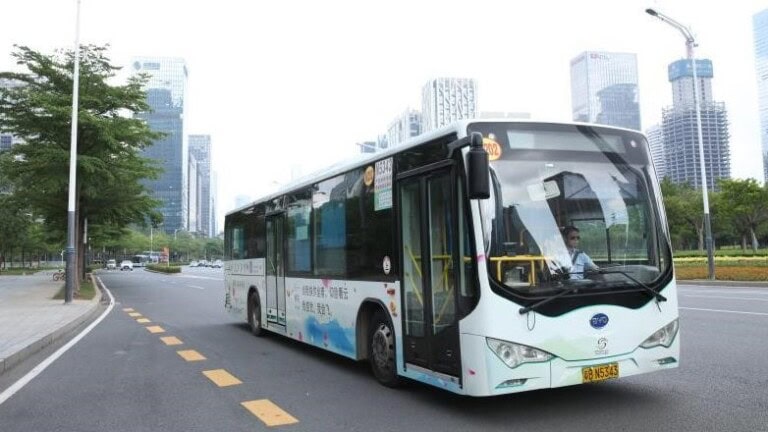
UITP Academy is launching an online course on Electric Bus Operations & Maintenance, along with Shenzhen Bus Group (SZBG), an operator who has achieved full electrification. The course runs from 19 to 27 September and features 8 interactive online sessions.
With most metropolitan areas targeting zero-emission environments, an increasing number of cities and transport companies are considering a fully electric solution for their urban bus network.
In this context, UITP Academy and Shenzhen Bus Group (SZBG) designed this training programme on the operations of Electric Buses to offer a comprehensive overview on the operations, maintenance and asset management of electric buses.
This training will give you an insight into urban bus networks, the importance of building a sustainable infrastructure, recent technologies, and using data for the operation, maintenance, scheduling and implementation of efficient timetables on city routes.
Shenzhen Bus Group (SZBG) is the largest and oldest public transportation operator in Shenzhen, China.
After achieving full electrification, with 6,053 electric buses in 2018, SZBG has now become the largest new energy public transport operator in the world.
SZBG has also been trialing electric self-driving buses on open and mix-traffic roads since 2017, with zero accidents to date.
The training and all training materials will be provided in English, and Simultaneous Interpretation (SI) from Chinese to English will be provided during this online training.
Reach your objectives
Adapt your bus operations towards a sustainable city
Introduce the electric solution, the different types of technologies, and compare their benefits and drawbacks
Understand the different types of vehicles and required infrastructure to operate and such vehicles
Discover the products on offer and the mainstream technology options available, the maturity level of suppliers, the various competition
Understand how to develop an operational and charging strategy
Learn how to plan, implement and run electric bus lines successfully
Understand how technology and data management can help optimise your operations and charging
Learn from successful major electric bus project operations and maintenance
Listen to best practices from around the globe
Why choose an online course?
Interact with public transport professionals from across the world
Be time efficient, with 8 sessions over a 2-week timespan
Flexibility to join the sessions from any location in the world, at work or at home
A top-level methodology
Participate in interactive online sessions which includes an introduction by course leaders and open discussions with participants
Apply your concepts during the online workshop
Exchange your current practices and experience with your peers
Each theme will be approached as followed:
Basic principles and conceptual approach
State of the art development and innovations
Good practices examples
Interactive exchange between participants and experts
UITP Training Programmes and all related processes are certified for ISO29990:2010 – the standard for learning services for non-formal education and training.
Who is it for?
Project managers, engineers and other professionals eager to learn more about the technology, the implementation and the running of electric buses
Staff from public transport operators who works in operation and maintenance
Staff from the bus industry worldwide involved in the market uptake of electric buses
Professionals interested in obtaining a wider and international perspective on electric buses and eager to learn more from international best practice
A good level of English is a compulsory requirement to attend the training except Chinese participants.
Inspiring trainers
Our skillful trainers are composed of international experts and professionals with extensive experience and knowledge in the strategic, operational and technological areas of electric buses.
Programme
Welcome & Introduction to the course, Expectation Analysis
08:00–08:45
Net zero
Embodied carbon
Scope 3
GHGs other than CO2,
Digital twinning
Lifecycle assessment (LCA)
Circularity & Systems thinking
The policy context and city strategies for the introduction of electric buses
Legislation/policy aspect: how to incentivize e-buses deployment with a focus on the EU Clean Vehicles Directive mandatory country targets and other international examples
Current state of the global electric bus market, the products on offer
Main challenges for deployment: upfront costs, operational requirements, procurement, interoperability, cooperation with energy sector.
Planification of charging infrastructure, a quite critical part when planning to deploy e-buses
The system approach and steps of an implementation and deployment process
Lean management is an approach to managing an organization that supports the concept of continuous improvement in order to improve efficiency and the quality for the customer. Working in a lean way means making staff on all levels actors taking ownership and engaging them in order to improve their work environment and work processes and at the same time deploying clear strategies.
The primary purpose of lean management is to produce value for the customer through the optimization of resources and create a steady workflow which is centered around the real needs of the clients. It seeks to eliminate any waste of time, effort or money by identifying each step in a business process and then revising or cutting out steps that do not create value for the customer. This will allow teams to focus its effort on value adding activities. Lean management facilitates shared leadership and responsibility; continuous improvement ensures that every employee contributes to the improvement process. The management method acts as a guide to building a successful, engaged and solid organization that is constantly progressing, identifying real problems and resolving them. The philosophy has its roots in manufacturing. Lean management is based on the Toyota production system which was established in the late 1940s, however its origins date back to Henry Ford. They found that significant improvements were made in efficiency, productivity, cost efficiency and cycle time.
In this session, Christiane will introduce you to the key concepts and some easy tools of lean management.
This session will look into new technologies and auxiliaries used to run electric busses, whether it be the installation and running of charging infrastructure, the impact on information technology systems, driver assistance and standardisation of the connection or the technical evolution of the battery.
This session includes:
An insight into vehicles (battery, plus-in hybrid, trolley, fuel cell) and infrastructure (overnight and opportunity charging, types of pantographs, in-motion charging)
Stae of the market from indusrty perspective
Updated electric bus product overview: latest models and trends
Understanding power demand from e-buses impacts infrastructure and operational costs and reliability
Choosing solutions and staging e-bus implementation is important to reduce overall costs and avoid rework.
How electricity sector play a role in optimising operational costs of ZEBs
Strategies that can effectively manage peak electricity demand during electric bus charging.
Session 3B: Timetable and scheduling of E-bus routes
10:15–11:00
Session 4: Electric Buses in China – Operations & Maintenance
08:00–09:15
Energy consumption, charging and overall performance need be monitored and managed in the most optimal way to ensure efficient and seamless electric bus operations. How to intelligently use data to achieve such performance will be presented and discussed in this session. Continuous improvement by integration of smart data (feedback loop) for the optimisation in operational simulations is thereby the key.
Managing successful efficient driving on bus operators has been a must for combustion vehicles. Urban EV fleet present a new challenge and possibilities for improving energy consumption and overall performance. Homogenizing driving styles according to vehicle makers and incorporating a continuous improving methodology can decisively contribute to a predictable operation, minimizing potential issues. This session will show how to walk the way in a successful approach.
Session 7: Case Study – Implementing and optimising large e-bus fleet operations
08:00–09:15
Technologies cell type
Behaviour
Management systems
Lifetime
Standards
Safety
Thermal management
Models
Regional perspectives on developments:
AU/New Zealand
China
Singapore
EU
Wrap Up and Closing
11:30–11:45
Trainers
Robert ALLENDER
Executive Director – Corporate Decarbonisation Strategy
EnergyUse Strategy Advisors (ESA)
Hong Kong SAR, China
Robert Allender is an energy and carbon management strategist, and creator of the Four Quadrants of Energy Management, a framework for taking energy beyond being a cost to be cut. Robert heads his own management consultancy, Energy Resources Management, founded in 1992, which serves companies and cities with a specialism in the non-engineering half of energy management.
Yiğit BELİN
Head of Sales, Bidding, Business Development & Project Contracts
Bozankaya A.Ş
Türkiye
Yiğit is an experienced, motivated and target-focused sales, bidding, project management and business development professional with a long-standing background in electric bus (First contracts and fleet in east Europe and Mena region)rolling stock (First local supplier contracts and export) industries.
He has a proven record of accomplishments, competence and dependability in implementing market and country specific sales strategies for each product as well as identifying new business opportunities and creating unique business models for each client.
Yiğit also has an extensive knowledge and hands-on experience on public tenders and bidding procedures as well as a vast network and an effective communication with clients, collaborators, shareholders and government officials.
He continually follows the latest trends and developments in sustainable mobility and brainstorm with the management and technical teams regularly to get the company further innovative and be the leading brand in our industry.
Christiane JUST
Founder and President
Contexture
France
Christiane is passionate about creating organizational performance by using lean management and coaching tools. Born in Germany, she started her international career at the UITP in Brussels. Since then she has worked and lived in the US, UK, Germany and is today based in Paris, France. She fluently speaks German, French and English.
She is a senior leader with an over 20 year career in the mobility sector, she has worked as general manager as well as in corporate leadership functions for a private mobility operator. Notably she was in charge of the lean transformation of the group Transdev achieving notable performance improvements.
As companies are facing multiple and more complex challenges today, they are forced to transform and change in order to respond to those challenges. Although AI and automation/ digitalization are important aspects of companies today, people are the driving forces and therefore her center of attention. She finds ways to accompany people to align processes, strategies and their leadership whilst companies use new opportunities and adjust.
Aside from her expertise in Lean management, she is a certified executive and team coach using a systemic approach. Her company Contexture offers coaching, consulting and training services for clients in Europe and the world.
Josep Enric GARCÍA ALEMANY
Public Transport Executive and Consultant
Spain
Josep is Partner and Director of Moov, a mobility and transport consultancy. He is a Civil Engineer by training and has developed his professional career to date in transport and sustainable mobility, at advisory, operational, and executive management levels. As a consultant and designer, Josep has undertaken transport infrastructure projects, Urban Mobility Plans, service usage assessments, urban and interurban public transport network modelling, traffic and parking demand studies.
As a service operator, Josep developed the technical office of the Transvia Group and was Managing Director of the Municipal Transport Company of València (EMT), where he led an intense process of transformation turning the organisation into a mobility management company, focused on efficiency, digitalisation and with a completely transformed network. As a result, EMT València service usage grew by 10%, becoming public transport company of the year in Spain in 2017 and awarded one of the best 50 companies to work for in Spain according to Forbes in 2018.
Darek KOPER
Project Director E-Mobility
UGL Transport
Australia
Darek is a change manager and influencer in the transition to sustainable transport. With over 16 years of industry experience, Darek is a driving force in advocating for decarbonisation of the transport sector with a focus on sustainable and environmentally friendly public transport to improve air quality and reduce greenhouse gas emissions. He delivers insightful advice, hosts impactful training sessions and symposiums.
Darek played a leading role in the decarbonisation of Auckland’s public transport bus and ferry fleets and infrastructure specifications. He led Auckland Transport’s transition to a zero emission bus fleet known as Auckland’s ‚Low Emission Bus Roadmap‘ aiming to transition the city’s public transport to zero emission buses by 2035 and low emission ferries by 2040. He chaired the New Zealand Low Emission Bus Working Group tasked with overcoming challenges and removing barriers to earlier adoption of zero emission buses in New Zealand.
Darek now works on accelerating the implementation of sustainable transport solutions in Australia and plays a key role in supporting the transition from diesel to electric and hydrogen fuel cell buses, trains, ferries, their management, operations and charging infrastructure.
Dr LIU Tao
Associate Professor of School of Transportation and Logistics
Southwest Jiaotong University
China
Dr Liu Tao is an Associate Professor of School of Transportation and Logistics, Southwest Jiaotong University. He received his PhD in Civil Engineering (Transportation) from the University of Auckland, New Zealand. He once worked at TUMCREATE Ltd., in Singapore, involved in developing an autonomous modular public transport system for megacities. His research focuses on the analysis, modelling and optimization of transportation systems, especially public transport and shared mobility systems. He has authored and co-authored over 50 papers in peer reviewed journals and conference proceedings, and 3 book chapters. Dr Liu serves as an associate editor, editor, guest editor, or editor board member of five international journals. He actively provides consulting services on public transport planning and operations for several transit companies in China.
ZHENG Penglin
Vehicle Expert, Technology & New Energy Department
Shenzhen Bus Group
China
Mr Zheng Penglin is the Senior Engineer in the Technology & New Energy Department at Shenzhen Bus Group, focusing on vehicle technology statistics analysis and technology innovative management.
He joined Shenzhen Bus Group since July 2016. He has ever been a technician at the workshop of bus fleets, and a technology statistics analyst at the Technology Department of a bus branch. He has also worked for Shenzhen City Transportation Association. He has experienced the transformation of electrification of Shenzhen Bus Group and has rich experiences in technical cost control and maintenance management of pure electric vehicles.
Jost GEWEKE
Business Development Manager at PSI Transcom
GmbH
Germany
Jost Geweke is responsible for business development and sales at PSI Transcom GmbH.
His focus is on the electrification of bus fleets and its impact on operations.
ITCS and train management solutions in the railway sector are another major field of activity.
He is a lawyer, has held management positions in the energy sector in Europe, and has been working in the public transport sector for many years.
Fernando APARICIO
Chief Commercial Officer
Bledsystem
Spain
Fernando is Chief Commercial Officer in Bledsystem. He played a decisive role in the development of the Bledsystem eco-driving solution (bledsystem.com). He led its introduction into the market and participated in the definition and deployment of Bledsystem at great scale international bus operators. He has a Telecommunications Engineering degree from the Universidad Politécnica de Valencia.
Oren ARIELI
Senior Product Manager
Optibus
Israel
Maria WEDENBY AHLBERG
Head of Public Affairs
Volvo Bus Corporation
Sweden
Maria has extensive experience in electromobility and sustainable transport solutions. Previously City Mobility Director at Volvo Buses, she has closely co-operated with cities, authorities and operators. Maria has represented Volvo Buses in international committees within industry organisations, such as UITP and ACEA. She has a Master of Science in Civil Engineering from Chalmers University of Technology in Sweden.
Tomas FORSBERG
Safety Manager
Volvo Bus Corporation
Sweden
Extensive experience in traffic and product safety within automotive industry.
Deep knowledge about electric vehicle development through various positions in the area.
Wide experience of cooperation and dialouge with authorities, PTA:s and PTO:s.
M. Sc. Automation & Mechatronics Chalmers University of Technology
Contact Us
Ozlem TATAR
Senior Manager, UITP Academy
Belgium
UITP Team
Poornima Singh
Manager for Research and Membership Services – Asia-Pacific RO