The concept: „Providing ‚Good Information‘ is 50% of any Mobility Service“
The aim of this training programme is to provide attendees with a full overview of what is at stake in the building and maintaining of a travel information system focused on user needs and expectations.
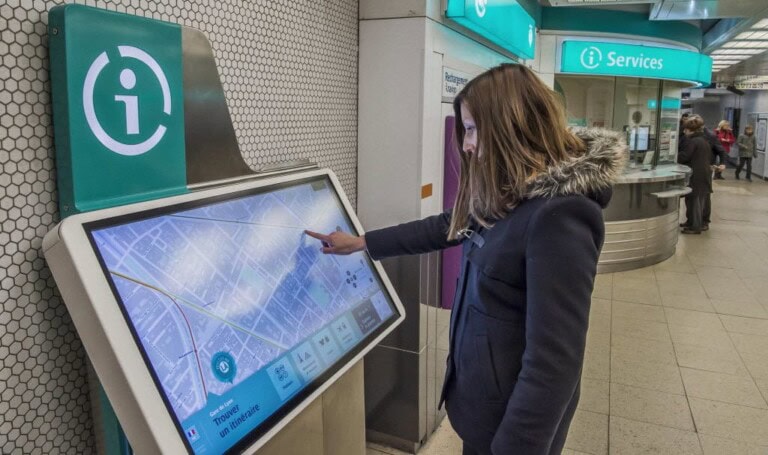
The programme will introduce and illustrate a practical toolbox of methods needed to actually design and deliver efficient wayshowing / wayfinding systems throughout the public transport user journey, organized in five main categories: space related information, time related information, orientation, service disruption, behaviour.
And Covid-19…
In the content of the current COVID19 pandemic, the programme will focus on how to improve existing public travel information / wayfinding systems to ensure relevance in a Covid / post-Covid environmentand will be combined with a workshop offering hands-on experience to participants.
Here’s what you will learn
Build an appropriate information design strategy to fit with the specific nature and any actual constraints of your network;
Build a rapidly-deployable intuitive and updateable wayfinding systemthat provides maps, information and travel advice in both digital and physical forms;
Design a passenger information system that keeps pace with an ever-changing Covid environment
Build a Covid World-relevant travel information master planwith a user centred focus;
The Online Training Programme will teach how to:
Make better decisions about yourinformation design strategy;
Better blend static and dynamicreal time informationinto your user’s journeys;
Build aCovid-robustwayfinding design systemto fit with the specific needs of your network;
Better manageservice disruptions;
Compare, Contrast and Benchmarkyour systems and processes against wayfinding services worldwide
Who is it for?
In-house information designers, project managers, engineers and other professionals eager to learn more about passenger information design
Professionals with positions in passenger information and customer service departments
Staff from public transport operators or authorities eager to develop passenger information in their public transport networks
Staff from the industry worldwide involved in the market uptake of passenger information technology and design
Professionals interested in obtaining a wider and international perspective on passenger information design and eager to learn more from best practice worldwide
A top level methodology
Get inspired by our trainers, understand the main aspects of way showing information design and learn from successful best practice
Participate to interactive plenary sessions with introduction by course leaders, presentation by trainers and open discussion with participants
Challenge your practical knowledge on the effectiveness and quality of information service provision
Address topics and issues from an international perspective, enriched by different cultural approaches and points of views
Participate in practical exercises ‘in the field’ allowing you to apply the principles and methods learnt during the training course
Benefit from a unique exchange of knowledge and experience between professionals
UITP Training Programmes and all related processes are certified for ISO29990:2010 – the standard for learning services for non-formal education and training.
Why choose an online course?
Be time efficient, with 8 sessions over a 3 week timespan
Interact with public transport professionals from across the world
Flexibility to join the sessions from any location in the world, at work or at home
Programme
What is good information design? Why do we need it?
Thinking information design as your ‘functional branding’ strategy
The user at the centre: building the ‘user journey’ model
Hybridization: delivering seamless experiences throughout physical and digital information
Building the framework: the challenge of combining functional aspects with a specific context of use
Crossing functions and user journeys: the right information, at the right moment, in the right place
Mastering the physical and the digital: strategy, governance, knowledge
Assessing the performance of your current system: evaluating its strengths and its pitfalls
Organizational stakes: skills and governance.
Getting the components right:
Space related information: cartography as a strategy
Time-related information: how to cope with ‘real time’ service expectation
Service Disruptions: dealing with anxiety, uncertainty and change
Orientation for journey navigation and wayfinding reassurance
Behaviour: PT networks as social spaces
Wayshowing: navigation in complex spaces
This session will focus on the usage of information and people’s cognitive capabilities while dealing with information when they’re (or planning to be) on the move. It will be followed by an introduction to the workshop and field work.
Workshop introduction:Capturing insights on the field in your own town or area
Field exercise: experience, observe and analyse the journey planning and navigation experience
Session 4: Workshop discussion in groups
10:00–12:00
Session 5 : Best practice from Europe
10:00–11:30
Accessibility is not about disability: it drives a better quality of use for everyone.
This session will develop an understanding for the many levels of perception that we use in order to gather, interpret, and act upon information. All levels are relevant for all of us to a greater or lesser degree. It is the challenge for information design to address all levels simultaneously and appropriately.
Just good design, no “special needs” design
How environment impacts perception, how we perceive our environment
Multi-sensory information: colour, contrast, touch and sound
The session will be delivered in two parts. In the short break between sessions a hands-on exercise will help sharpen participants’ perception for everyday information barriers.
Mapping for better Travel Information
More than just playing a functional role in an information and wayfinding system, mapping is also an excellent tool in promoting any transport network. Mapping done well can seemlessly link together different modes and journeys, as well as influence the behaviour and choices of those who navigate around your city. This session will draw on best practice real-world examples, and offer strategies for maximising mapping’s impact.
Sound Design applied to Passenger Information
Wayfinding is at the heart of any public transport system. It relies on a good signage system… but not only. One aspect that should be treated equally is sometimes overlooked by transit agencies: automatic audio announcements. This presentation will compare how audio announcements are managed by different transport operators worldwide and give the keys to give the right information at the right moment, to avoid unnecessary noise pollution that will annoy customers.
Asia is home to the fastest-growing rapid transit systems in the world with heavy-ridership stations. This session will review multiple example and recent wayfinding improvements as different wayfinding situations require different support. Furthermore, cultural dispositions, sensory abilities, orientation abilities, and personal mobility may impact the choice of a suitable way. Each of these circumstances may differ for a specific wayfinding support situation.
Conclusions & workshop discussions
11:00–12:00
Trainers
Jaspal SINGH
Senior Director
Membership & Global Operations
Canada
Jaspal Singh is a global mobility leader with over 20 years of experience spanning public transport, innovation, technology, and international business. He currently serves as Senior Director of Membership and Global Operations (MGO) at UITP (International Association of Public Transport), where he leads a global team of more than 32 professionals across 16 cities. In this role, he drives UITP’s global engagement strategy, strengthens international partnerships, and expands the association’s worldwide network to advance sustainable urban mobility.
Throughout his career, Jaspal has held several leadership positions at UITP, including Head of North America, Head of South Asia, and Manager of the IT and Innovation Committee. He was also part of Uber’s early journey, supporting regulatory engagement and strategic partnerships. His experience working with public transport authorities, operators, technology companies, startups, and consulting firms provides him with a unique 360-degree perspective on the evolving mobility ecosystem.
Passionate about innovation and entrepreneurship, Jaspal actively supports emerging mobility and autonomous transportation ventures as an advisor, mentor, and investor. He is the co-founder of Mobility Innovation Lab (MIL), a platform connecting startups, cities, and corporations to accelerate mobility innovation. He also hosts the Mobility Innovators Podcast, where he engages with global industry leaders, entrepreneurs, and policymakers shaping the future of transportation.
Recognized for his contributions to public transport and community service, Jaspal has received several awards and has been featured and quoted in industry publications. He holds a Master of Management Innovation and Entrepreneurship (MMIE) from Queen’s University, Canada, and a Master of Business Administration (MBA) specializing in International Business.
Aïcha KONATE
Design Researcher & Strategist | Service Designer
Attoma
With a combined academic background in the social sciences and design, Aïcha specialises in user research and service design in cross-cultural contexts. Over the past six years she has been working as a consultant throughout Europe and the United States, helping companies to better understand their users.
Aïcha is passionate about exploring how people think and make decisions. She leverages these insights about the needs of individuals and groups to create products, services, and experiences that connect organisations to their users.
At attoma, Aïcha works with various research methodologies, from interviews and user testing to immersive fieldwork and co-design workshops. She then transforms the findings from this research into actionable insights for the agency’s clients.
Aïcha also enjoys facilitating user research training workshops so she can share with others how to conduct research, and how to analyse its findings to create experiences that are truly user-centred.
Yo KAMINAGAI
Expert in Urban Mobility Design
France
Graduating university as a civil engineer, Yo joined RATP in 1980. He began in the marketing team and was duly put in charge of Passenger Information. Over the ensuing years, Yo worked to build up RATP’s Design Management function – progressively integrating all the creative disciplines related to transport environment design – product design, information design, architecture, arts and culture management – becoming Head of Design Projects Management in 2011. Yo retired from RATP in December 2023 after 35 years with the company.
Yo’s department steered many of RATP’s infrastructure investment projects, coordinates policies and ensures the inclusion of Design Quality in RATP Group’s corporate strategy.
He serves on the boards of several organizations focussed on design promotion and design education in France and is a former Chair of the UITP Design & Culture Committee.
Giuseppe ATTOMA
Senior Design Strategist
Attoma
France
Holding a PhD in Cultural Studies and Media at the University of Nottingham and Master’s degree in Semiotics at the University of Bologna, Alessandro as a 7 years’ experience in innovation, service design and user experience in a multidisciplinary and international environment. He is an
expert of qualitative research on users, behaviors and strategy. He worked as research manager in for consulting companies, digital agencies and marketing and brand strategy research firms in Berlin, Geneva and Paris.
At Attoma, he is responsible of the User Research activities, from the design of research
methodologies to the recommendations to bring user insights at the heart of enterprise
innovation strategies. He has managed and conducted extensive fieldwork and
research within the transportation sectors in particular about user behaviors and digital
usages within public transportation spaces.
Christian Nordström
Design Manager
Ruter
Christian Nordström studied print technology at Gjøvik University College (Norway) and information design at the University of Reading (UK). He previously worked at Suunto Oy (Finland), being responsible for the design and development of product manuals and packaging.
Christian has since 2013 worked at the public transport authority for Oslo and Akershus counties, Ruter As (Norway), starting as an information designer and now working as design manager. He is involved in digital-, print-, industrial- and service design projects.
Veronika EGGER
Information Designer
is-design
Austria
Veronika is an information designer with 30 years experience and focus on mobility and inclusive design. She believes in a collaborative and multidisciplinary approach to arrive at the best possible solutions for everyone.
In 1997 she founded her own company – ‘is-design’, making information, buildings, products and environments understandable and easy to use. Her projects are in public transport and other public spaces such as universities, hospitals, civic buildings and historic spaces.
She has been a partner in mobility research projects and is published internationally on mobility and inclusive information design. Veronika is President of the International Institute for Information Design (IIID) and co-founder of ‘design for all’ – an organisation promoting inclusive design in Austria.
Sergio LUKE
Principal Advisor
T-Kartor
United Kingdom
Sergio has over 15 years experience in public transport service delivery, in both the public and private sectors. He fulfilled a variety of roles during a decade at Transport for London (TfL), producing passenger-oriented service information. While at TfL, Sergio delivered information campaigns and managed business-as-usual information products for every mode of transport in the UK’s capital – from the London Underground to buses, trams, river boats, cycling and walking. Highlights include his Quality Assurance responsibility for the roll-out of the ‘Legible London’ pedestrian wayfinding system; authorship of travel advice for locals and visitors during the London 2012 Olympic Games; and stewardship of London’s iconic Tube Map.
Sergio is currently a Principal Advisor for Geospatial and City Wayfinding at T-Kartor, where he continues his focus on a well-designed, well-executed information strategy as a key component in any transport or city authority’s relationship with it’s service users. Chief among his concerns is how to get us all walking more through the aid of a good map!
Song Phanekham
Manager of Brand Identity, Heritage Assets and Sound Design
RATP Group
France
After graduating in Communications at the Institut Français de Presse, Song joined RATP in 1999. He worked on several internet and intranet projects, before supervising the design and editorial content of various websites launched by RATP in 2002. He then took charge of the daily administration for the RATP main website.
In 2005, Song was put in charge of redefining RATP’s general visual identity guidelines for all published materials. Many templates were created, especially for surface transport operations. During this work, Song included sound identity. Having worked at Disneyland Paris when he was a student, Song saw the potential of audio announcements as an effective passenger communications medium. By travelling around the world and observing many transport systems, he developed RATP’s passenger audio information standards. His work includes the composition of musical themes (chimes) for use in stations and vehicles, the selection of audio announcement voices and the specifications for the automated RATP Passenger Audio Information System.