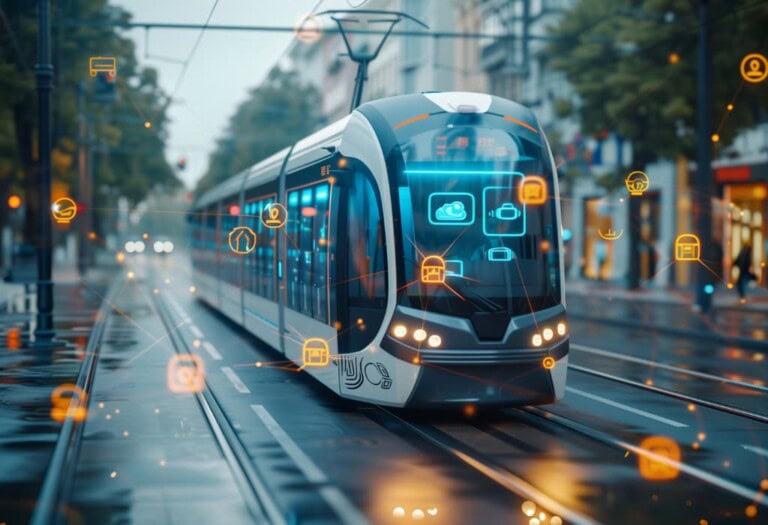
Data has long been at the heart of public transport planning, operations and policymaking. Today, the volume, variety and speed of data generated by public transport systems have increased dramatically, creating both unprecedented opportunities and significant challenges.
Business Intelligence (BI) provides the essential foundation to transform raw data into actionable insights, enabling decision-makers to improve service quality, operational performance, financial sustainability and customer satisfaction.
As public transport organizations mature in their use of data, Artificial Intelligence (AI) is emerging as a powerful next step to further unlock value. AI and Machine Learning build upon well-structured, reliable and well-governed data environments to enhance prediction, optimization and automation across the public transport value chain.
From demand forecasting and dynamic scheduling to asset management, customer service and safety, AI applications can significantly improve efficiency, resilience and passenger experience.
This blended training program is designed to guide participants along the full data journey in public transport: from data fundamentals and Business Intelligence, through advanced analytics, and finally to practical and strategic applications of AI.
The program emphasises that strong data governance, sound KPIs, and effective BI systems are prerequisites for successful AI adoption.
Through expert-led sessions, case studies, workshops and peer exchange, participants will learn how to structure their data, define meaningful indicators, build dashboards, and progressively leverage AI to support smarter decisions and more intelligent transport systems.
The course also explores the role of Open Data, data sharing, innovation ecosystems and organizational change as key enablers of both BI and AI.
What You Will Learn
Learn about the main principles, processes and tools required to use data and build a sound business intelligence system and organization to improve public transport and sustainable urban mobility in cities
Understand the importance of having a good organization of data and learn from best practice on implementing a management information system
Learn from international best practices and exchange of knowledge on the optimal use of new technologies
Learn how to better exploit data analytics and find opportunities in your data, in particular Big Data analysis
Apply through workshops, the process of getting the right data: from defining strategic goals to the appropriate selection and break down of indicators.
Understand and discuss the concept of AI and Machine Learning
Broaden your knowledge and perspective on possible applications of artificial intelligence in public transport by learning and sharing experience with professional leaders
Learn about the possible opportunities for making public transport modes more efficient and customer oriented with artificial intelligence applications
Understand the impact of new technology and how organizations can leverage on the opportunity
Learn from best practices from around the world: showcases from local operators, authorities and the industry
Learn about approaches, challenges and possible causes of failures in implementing AI projects in the public transport industry
Who is it for?
Transport professionals who want to get more out of their available data whatever the field of specialization, from operations management to public transport planning, marketing and strategic decision making
Professionals in IT and Business analytics who are willing to widen experience directly involved in the collection, processing, and analysis of data
Professionals interested in obtaining a wider and more international perspective on the collection and use of data in public transport
Experienced professionals but also newcomers in the sector from local transport authorities, public transport operators or the supply industry.
Programme
Matt KIRSON, Head of North America, UITP
Session 1
Ferdinand BURGERSDIJK, Data governance expert, FRCB, The Netherlands
Data has been in and around public transport for some time now. It has not only changed the way Public Transport is operated and used, but it has also changed expectations passengers have. Which changes have taken place in general, and which in the regions of participants? What is expected to happen in the future? And how will this impact passenger expectations? In this first session all these items will be discussed.
Session 2
Dr. Manjit SOOCH, Director of Innovation and Technology, Alameda-Contra Costa Transit District
This session will look into the use and impact of new technologies, which open up new perspectives in the way data is collected. Apart from the secondary data, a large amount of primary data is being collected from smart cards, telematics systems, GPS systems and vehicle detection systems, almost on a real-time basis. In addition, large amount of customer or operational data is available through crowd sourcing, social media, and smart device interactions. This exponential growth in data has opened new opportunities but at the same challenged business organizations on four fronts – Volume, Velocity, Veracity and Variety. The techniques to bring this data together and organize them in a Big Data Analytics framework can lead to higher revenue (and customer service), lower costs (efficiency and optimization) and innovation (new business products).
Lunch
12:30–13:30
Session 3
Giovanna CENTONZE, Operations Analytics Expert, Geneva Public Transport (tpg), Switzerland
Delays, ridership, distances, travel times, speeds and intersection clearance times
Safety: accidents, roadworks and related factors
Strategic workforce planning and absenteeism
Transport service planning
Ticket inspection monitoring
Coffee break
15:00–15:30
Tyler OATHES, Assistant Professor, Rutgers
End of the day 1
16:00–16:00
Session 4
Aurélien COTTET, President, 4D industries, France
Artificial Intelligence, AI, Big Data and Machine Learning, ML
AI in Customer Service
AI in Operational Efficiency and Asset Management
AI in Safety and Security Management
Open Data
Data Managements for Service Excellence
Data Managements for Customer Satisfactions
Coffee break
10:00–10:30
Case Study: Ticketing
10:30–11:00
Session 5
Ferdinand BURGERSDIJK, Data governance expert, FRCB, The Netherlands
Working within the tight margins of scarce resources and high expectations. This course will give insights into what data governance entails with key building blocks. A foundation to extract value from your organizations’ data.
Data roles
Data governance
Data sovereignty
Know your supplier
Open is not ‘for free’
Value cases
Ferdinand BURGERSDIJK, Data governance expert, FRCB, The Netherlands Aurélien COTTET, President, 4D industries, France
Workshop 1 – How data-driven should your organisation be?
Based upon Gartner’s BI maturity model participants will rank their own company: how data driven is your organisation? How data driven does it need to be? How to get there?
Workshop 2: How to get from data to results?
Many operators struggle to optimize the impact of data. What should be done to get the max out of data? How to avoid failure? How to get a high ROI (Return on Investment)? In this session conditions for success will be discussed.
Lunch
12:30–13:30
Session 6
Giovanna CENTONZE, Operations Analytics Expert, Geneva Public Transport (tpg), Switzerland
Coffee break
15:00–15:15
Session 7
Ferdinand BURGERSDIJK, Data governance expert, FRCB, The Netherlands Aurélien COTTET, President, 4D industries, France
Creation
In companies including public transport companies KPI’s plays very crucial roles for decision making process. Collecting and analysing the data should come up with the results to follow daily, weekly, monthly, and annual basis by the management. Companies should define their own KPI’s and success criteria to monitor the trends within the results.
Success factor for PTO’s
Key Performance Indicators, KPI’s,
Performance Indicators, PI’s
How to create KPI’s
Performance monitoring
KPI’s can be used and implement for various activities in public transport. By using definite KPI’s each level of managements from medium management to top can monitor the results and ack accordingly. It is called managing by the results. KPIs gives ability to decision makers where to intervene into the process.
Performance monitoring for different elements,
Defining KPI’s for different activities
Monitoring maintenance, operations, finance by KPI’s
End of the day 2
16:00–16:00
Session 8
Ferdinand BURGERSDIJK, Data governance expert, FRCB
Coffee break
10:30–11:00
Session 9
Ferdinand BURGERSDIJK, Data governance expert, FRCB, The Netherlands Aurélien COTTET, President, 4D industries, France
Workshop 3 – KPI selection
What is a good KPI? And how to select KPIs that really make a difference in terms of quality, proqfit and customer satisfaction? In this workshop this process is explained and executed.
Workshop 4 – Action planning
One of the biggest challenges is to use data not just to monitor your KPIs, but also to manage your KPIs, so for improving quality, profit and customer satisfaction. But how do you do that? In this session this process is explained and participants are supported in creating their own action-planning.
End of Programme
13:00–13:00
A Top Level Methodology
Get inspired by trainers, understand the main aspects of bus planning and scheduling systems
Participate in interactive plenary sessions with an introduction by course leaders, presentation by trainers, and open discussions with participants
Challenge your practical knowledge of bus planning and scheduling
Address the topic from an international perspective, enriched by different cultural approaches and points of view
Participate in practical exercises and case studies
Benefit from a unique exchange of knowledge and experience between professionals
Exchange experiences and discuss key topics during workshops in smaller groups
UITP Training Programs and all related processes are certified for ISO 21001: 2018 – the standard for Educational organizations – Management systems for educational organizations.
Dr. Manjit Sooch is the Director of Innovation and Technology at AC Transit, bringing over 25 years of experience in enterprise applications and software development lifecycles across both sectors.
As Chair of the APTA Research and Technology Committee and Board Member, she champions technological innovation and research for APTA members.
Manjit holds a doctorate in business administration from the University of the Southwest, an MBA in IT Management from Western Governors University, and a bachelor’s degree in business and software engineering from Delhi University. An ENO Leadership Program alumna, she also dedicates time as a volunteer Director of the Women’s Chapter at the Universal Brotherhood.
Her expertise encompasses a powerful mix of technical, interpersonal, and leadership skills.
Giovanna CENTONZE
Analytical and Optimisation Expert at Public Transport of Geneva (TPG)
Switzerland
Giovanna Centonze holds a Master’s degree in Management Engineering from Milan, Italy, earned between 1999 and 2005. Following this, she pursued a Master’s in Development Economics at the University of East Anglia (UEA) in Norwich, UK, completing her studies in 2009.
She has worked across various sectors and international environments. She began her career in Milan as a business analyst at a consulting firm, focusing on process optimisation. After a one-year experience in Spain in European project she worked in Geneva, with the International Labour Organization (ILO) in monitoring and evaluation, followed by consultancy with World Vision International (WVI) on community health projects. She furthered her expertise as a Knowledge Management Officer at ILO, overseeing the Global Job Pact. In Lausanne, she served as a Programme Management Officer, contributing to project monitoring, process optimisation, and tool development for projects such as “Chiclayo Limpio” in Peru.
Since April 2016, Giovanna has served as an Analytical Expert at Transports Publics Genevois in Geneva, Switzerland. In this capacity, she leads the activities of the analytical unit of TPG, responsible for collecting, analysing, and guiding business decisions through TPG data.
Ferdinand BURGERSDIJK
Chief Executive Officer,
FRCB B.V.
Netherlands
With a clear view and pragmatic contributions to businesses, and authorities up to EU data strategy deployments, Ferdinand is a thought leader for a fair data and digital economy. Leveraging legal principles to enable individuals, businesses and authorities to easily manage data, catering to the outcomes they want, while neither compromising on privacy nor convenience. With a background in law, business administration and philosophy, Ferdinand helps organisations in the mobility domain to get a grip on ‘all things data’, supporting their data governance, change management and strategic alignment with their information and business processes.
Data processing is like a production line of individual activities contributing to a desired outcome. For each activity one can plan the input and throughput to deliver the output. Seeing that many systems organise similar activities, it’s only logical to align them. This view led to the development and deployment a data sharing protocol easy to integrate with whatever (personal) data management system in place, fairsfair.io. Supported by an open source semantic model, fostering interoperability and compliance, fairsfair.org.
Aurelien COTTET
Regional Managing Director West EMEA
Optibus
France
Aurelien joined OPTIBUS in 2023 after being at INSTANT System as the International Sales Director. He spent several years at Transdev, where he began as a Sales and Marketing Manager in the Autonomous Vehicle Department. He rapidly advanced to become the Worldwide MaaS Projects Coordinator, overseeing all the local MaaS projects in each country where Transdev was present. He was also the operational link between Transdev and its MaaS Investments such as MaaS Global and Tranzer.
He was elected to the Board of Directors of Maas Alliance to represent Transdev.
He started his career as an entrepreneur just after graduating with his Master of Science degree in Aerospace Engineering, earned at Georgia Tech (USA). He also holds a Master of Science degree in Mechanical Engineering from UTC (Compiegne, France).
He has over 20 years of experience as an International Business Developer and Strategist in diverse fields, such as semi component, roaming telecom, telecom billing validation, telecom anti-fraud, IT security using two-factor authentication, and Factory 4.0 with Testia (an Airbus Group Company).
Now Aurelien brings to INSTANT System his comprehensive experience in complex projects and his extensive knowledge of the different MaaS markets around the world, allowing INSTANT System to offer a tailored MaaS solution which best meets each market’s local specificities and needs.
Contact Us
Have a question? Contact our team if you need any additional information on this event.