
COP 31: Climate Finance Opportunity for Public Transport

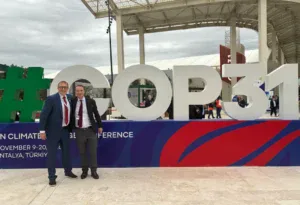
At COP31 in Antalya, Türkiye, UITP made the case for putting public transport at the heart of climate discussions and climate action, and the need to unlock climate finance for the sector.
UITP’s delegation was led by UITP President Gautier Brodeo and Head of Sustainable Development Philip Turner. Through meetings with policymakers, panel discussions and publication launches, UITP highlighted public transport’s contribution to climate action and the importance of securing the investment needed to expand it.
Climate Financing for Public Transport
The potential and need to unlock climate financing for public transport is clear.
The MoveCredits Coalition, launched by UITP, UIC and Alstom, was in the spotlight at the Transport Pavilion during a panel on leveraging carbon markets to accelerate rail and public transport.
The Coalition aims to make climate finance more accessible by updating carbon credit methodologies in line with Article 6 of the Paris Agreement. It will also promote cooperation, advocacy, and harmonised standards to recognise the climate benefits of rail and public transport projects across financing instruments.
Gautier called on national governments to engage with and join the Coalition. By helping scale up carbon markets, the initiative could strengthen project bankability and reduce investment risks for sustainable transport.


Scaling Up Plans to Accelerate Solutions
UITP also called for stronger implementation of the COP Action Agenda and its Plans to Accelerate Solutions (PAS). The Plan to Scale Up Public and Sustainable Transport in Cities can help turn climate commitments into action ahead of the second Global Stocktake (GST-2) at COP33.
Since COP30, partners have expanded capacity-building, policy support, climate finance and public engagement. In 2026, approximately 3,000 transport professionals received training. The plan advances the Avoid and Shift Breakthrough through five levers: capacity-building, policy integration, finance, partnerships and public support.
The first World Public Transport Day, celebrated in 150 cities across more than 75 countries, showed growing global momentum for public transport and active mobility. Sustaining that momentum will require continued government engagement and support.
This message ran through COP31’s events, including “Solutions and Results: Scaling Up Implementation of Low-Carbon and Resilient Mobility” at the Mediterranean Pavilion, co-organised by the Union for the Mediterranean, UITP, UIC and Alstom.
UITP, SLOCAT and UIC also co-organised a UNFCCC side event on delivering the Paris Agreement and the UN Decade of Sustainable Transport. Both sessions emphasised the need to scale up action and implement the PAS.
More Public Transport in Climate Plans
Urban transport accounts for around 40% of global transport emissions. Scaling up sustainable mobility could double public transport’s modal share and cut urban transport emissions by up to 50%.
Nationally Determined Contributions (NDCs) are countries’ climate action plans under the Paris Agreement. They set out national goals for cutting greenhouse gas emissions and adapting to climate change, and are updated every five years.
UITP’s analysis finds that public transport is increasingly included in NDC targets, but there is still significant room to strengthen these commitments and shift more journeys to public transport. Doing so can reduce emissions and help create cleaner cities.
On National Adaption Plans (NAPs), which is a strategic framework created by developing countries under the UNFCCC to plan for medium- and long-term climate change adaptation, UITP is also putting public transport on the agenda.
Of 89 NAPs submitted to the UNFCCC by June 2026, around one-third include public transport measures aligned with the Avoid – Shift – Improve – Adapt framework. In collaboration with UNFCCC, UITP is working to ensure that public transport will feature more in these plans as part of UNFCC’s objective of building resilience for cities.



Integrating Housing, Public Transport and Sustainable Cities
Nearly 40% of the world’s urban population lacks convenient access to public transport. How cities plan housing and transport together can shape access to jobs and essential services, reduce emissions and support more resilient, inclusive communities.
At COP31, UITP, UN-Habitat and ICLEI launched their joint publication on housing, public transport and sustainable cities. It calls for public transport to be recognised as central to resilient, inclusive urban development and climate action. The publication recommends compact, transit-oriented development, land value capture and people-centred policies to improve access while reducing car dependency, energy use and emissions.
The UN Decade of Sustainable Transport offers an important opportunity to advance these integrated approaches and deliver on Sustainable Development Goal 11.2: access to safe, affordable, accessible and sustainable transport for all.
Gautier Brodeo
UITP President

Looking Ahead
With the UN Decade of Sustainable Transport underway and the first World Public Transport Day demonstrating the sector’s reach, the next step is to turn momentum into action. That means directing climate finance towards effective solutions that help tackle climate change.
Initiatives such as the MoveCredits Coalition can help unlock new financing for public transport and rail, supporting the goals of the Decade and the wider climate objectives of the Paris Agreement.