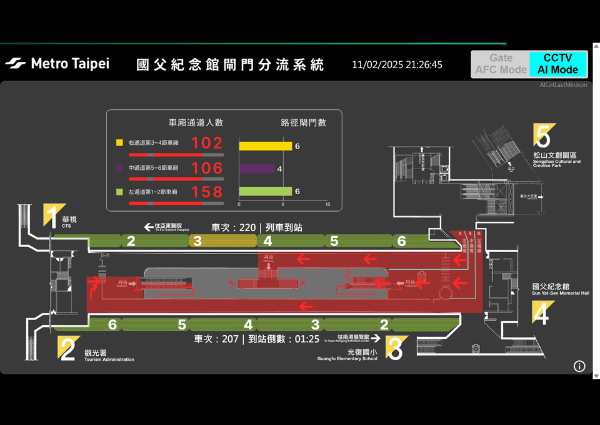
AI-driven Passenger Flow Management System at Sun Yat-Sen Memorial Hall Station
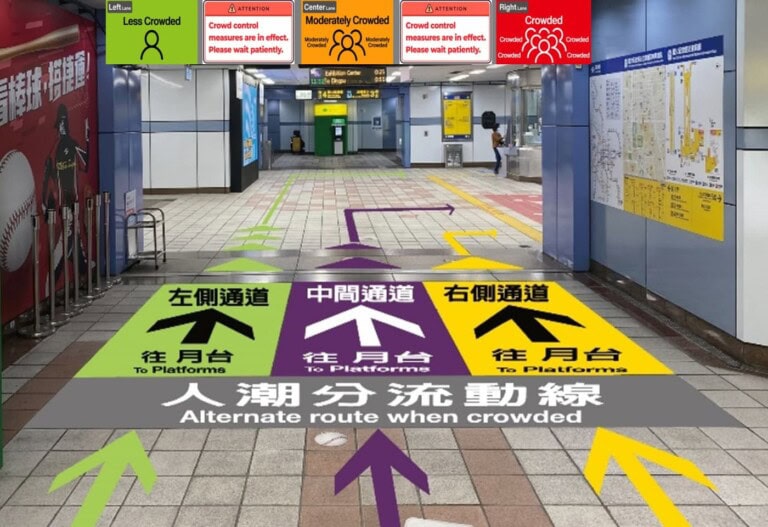

This project enhances crowd safety after large events, especially at the 40,000-seat Taipei Dome. Using AI image recognition, edge computing, and real-time visual guidance, it enables proactive, data-driven crowd management and safer station operations.

About this Project
Taipei Metro, serving over two million passengers daily, faces significant crowd management challenges, particularly after events at the 40,000-seat Taipei Dome, where dispersal crowds rapidly converge at Sun Yat-Sen Memorial Hall Station.
Traditional reliance on ticketing data and manual observation was limited by data latency and human judgement, reducing responsiveness to real-time crowd surges and increasing public safety risk.
Taipei Metro implemented an AI-driven Gate Crowd Flow Display System to estimate real-time crowd levels with over 90% accuracy. Congestion updates refresh every 10 seconds and are shown via color-coded displays and guiding light bars, enabling self-directed dispersion.
Integrated with Metro TIMES and NTDS, it supported 162 events (3.85M attendees) from Mar 2024–Sep 2025, reducing dispersal time to 33.2 minutes with zero safety incidents.
Key Highlights
- Proactive Risk Management: Inspired by the 2022 Itaewon tragedy, the system replaces manpower-based regulation with proactive monitoring and early warnings to detect and prevent gate congestion.
- AI-Driven Decisions: Combines AI algorithms with ticketing and historical data to predict real-time crowd levels, resolving data delay issues and improving operational precision.
- Inclusive Visual Design: Uses red-yellow-green indicators and icons for easy comprehension by passengers of all ages and backgrounds.
- Integrated Data Platform: Unifies ticketing, CCTV, and IoT data to enhance situational awareness and system resilience.
- Scalable Modular Architecture: Allows flexible parameter tuning and replication across stations.
Facts & Figures
- The system improved passenger distribution, increasing average car occupancy from 60.98% to 65% and reducing post-event dispersal time by 8 minutes.
- Flow diversion reached 42% (right), 30% (center), 28% (left).
- Station support staff was reduced from 39 to 29.
- The system was deployed in 162 events (3.85M attendees), achieving an average 33.2-minute dispersal with zero safety incidents, while enhancing operational efficiency, passenger autonomy, and urban mobility resilience.